Sunday, April 26, 2009

RELEASE: Statement from Town and Gown Players


ATHENS (MyFOX ATLANTA) - The three people we lost yesterday were a part of the rich 50-year history of this theater and, more than that, were vital members of the Town and Gown family.

Ben Teague, loving husband of UGA's Dr. Fran Teague for more than 40 years, was not only a friend but also a father figure to all at the theater. One would be hard pressed to find a Town and Gowner who had not learned at least one life lesson from this wise and kind hearted man. His wife wishes to say, "Yesterday Ben was murdered, which is hard to comprehend and impossible to accept. It was a beautiful day, however, and he was in his favorite place with the people he loved." Ben was a translator of German, Russian and English.

Marie Bruce was the binding force that held the Town and Gown community together. Having worked with Town and Gown for over 20 years, at one time or another she served in every capacity at the theater, artistically and administratively, from leading lady to president of the board to chief cook and bottle washer. A local attorney, Marie was the mother of two young children.

A gentle presence, Tom Tanner breathed life into every corner of Town and Gown through his quiet diligence and astounding creativity - most would call him genius. Father of an equally amazing daughter, Tom would tell you that while he enjoyed his work as director of the Regional Dynamics Economic Modeling Laboratory at Clemson University, his heart lived and thrived in the theater.

Ben, Marie and Tom were a part of our family, and as painful as their loss is for us, we know it is even more painful for their families. We want to extend our deepest sympathy to their immediate family and close friends outside the theater community. There are no words we can use to adequately express our grief.

We would like to thank the Athens Police department and the media for their respectful treatment of this tragedy. We want to thank the American Bio Recovery Association and A1 BIO-Clean Service for the generous donation of their services in our time of need. We also want to thank the Athens Community for their support. This tragedy effects everyone in the community in some way, and we know you share in our loss. We ask that the media continue to be respectful of our privacy during this difficult time.

Wednesday, April 22, 2009

Custodian’s stress-disorder suit restored


Meghann M. Cuniff / Staff writer

A custodian who sued her school district after being forced to clean up the bloody scene of a student’s suicide had her lawsuit reinstated Tuesday by the Washington Court of Appeals.

Debbie Rothwell, who still works at Lakeside High School in Nine Mile Falls, suffers from post-traumatic stress disorder, according to a lawsuit filed in May 2007 by her lawyer, William Powell, of Spokane. The 16-year-old student shot himself in the head inside the school’s main entrance in 2004. The lawsuit was dismissed in January 2008 by Spokane County Superior Court Judge Greg Sypolt, who ruled the incident was covered by the Industrial Insurance Act.

But the Court of Appeals, in a 2-1 ruling, disagreed and reinstated the suit.

“There are people who do clean up the mess after one of these horrible murders or suicides happen,” Powell said Tuesday, referring to private professionals. “But the superintendent in this case chose not to do that. He should have known better.”

Along with former Superintendent Michael Green, now superintendent of the Woodland School District in Western Washington, the lawsuit names the Nine Miles Falls School District, Stevens County Sheriff Craig Thayer, two sheriff’s detectives and an unidentified man as defendants.

None was available for comment. Like most civil suits in Washington, the complaint seeks unspecified damages.

Rothwell’s complaints center around her task of cleaning up the suicide scene, then being asked to move a backpack she later learned belonged to the victim and contained a suspicious device that authorities detonated using a robot.

She stayed at work until after 4 a.m., cleaning the mess of blood, brain and bone alone, becoming “emotionally distraught and physically ill” before returning to the school less than four hours later at Green’s orders to serve cookies and coffee to grieving students and keep the media from the school, according to the suit.

At issue in the court decisions was whether Rothwell’s claim of post-traumatic stress disorder fell under the industrial injury act, which prohibits lawsuits based on industry injury or occupational disease.

Judges John A. Schultheis and Dennis J. Sweeney ruled it didn’t because it wasn’t the result of one work order. Her trauma grew over several days, according to their written opinion. Judge Teresa C. Kulik dissented.

Monday, April 6, 2009

Cleanup completed at Civic Association


April 5, 2009

Cleanup has been completed at the American Civic Association building in Binghamton, where a gunman killed 13 people and injured four before taking his own life Friday.

The American Bio-Recovery Association, a non-profit international association of crime and trauma scene professionals, said Sunday that the bio-recovery cleaning was complete. The Ipswich, Mass.-based group provided the service at no cost.

Two member companies, Disaster Clean Up of Endwell and the Bio-Recovery Corporation of New York City, donated labor and supplies to remediate the scene with a crew of six technicians.

Cleanup completed at Civic Association


Cleanup has been completed at the American Civic Association building in Binghamton, where a gunman killed 13 people and injured four before taking his own life Friday.

The American Bio-Recovery Association, a non-profit international association of crime and trauma scene professionals, said Sunday that the bio-recovery cleaning was complete. The Ipswich, Mass.-based group provided the service at no cost.

Two member companies, Disaster Clean Up of Endwell and the Bio-Recovery Corporation of New York City, donated labor and supplies to remediate the scene with a crew of six technicians.

Sunday, April 5, 2009

Bio-Recovery Corporation Aids In Binghamton Crime Scene Cleanup

PRESS RELEASE
April 5th 2009

Bio-Recovery Corporation of New York City and Diaster Scene Cleanup of Endwell, NY responded to the American Civic Association on April 5th 2009 at the request of the American Bio-Recovery Association to aid the American Civic Association and the entire Binghamton community with the cleanup of the crime scene left in the aftermath of Fridays multiple homicide, suicide at their offices located at 131 Front St Binghamton, NY.

At the request of Dale Cillian, President of the non profit American Bio-Recovery Association (ABRA), the two named companies above provided all the labor and equipment to complete this cleanup in one day at no cost to the American Civic Association. "I couldn't have done this without you guys," stated Andrew Baranoski, Executive Director of the non-profit American Civic Association.

The American Bio Recovery Association, an international association of Crime & Trauma Scene Cleanup professionals strives to make these services available to all that require it throughout the United States.

Saturday, February 28, 2009

The Top 13 Worst Jobs with the Best Pay


These are dirty jobs and somebody has to do them. At least they get paid well for their efforts
Think you have a lousy job? You're not alone. So do about half of your fellow workers—and about a quarter of them are only showing up to collect a paycheck, according to a survey conducted by London-based market information company TNS. Grumbling over the size of that check is common, too. About two-thirds of workers believe they don't get paid enough, says TNS—even though many of them may actually be overpaid, compared to average compensation data

Crime-Scene Cleaner
Average pay: $50,400
If crime-scene cleanup was just wiping blood off the floors—well, that would be easy. But CSI fans with get-rich-quick dreams should note the job involves more than handiness with a mop and a tolerance for the smell of decomposing flesh. Getting rid of bodily fluids typically calls for more rough-and-ready methods, such as ripping up carpet, tile, and baseboards. It also sometimes means working in confined spaces (if someone was electrocuted in an attic, for example). And when tearing up old houses, workers face exposure to hazards such as lead paint and asbestos—not to mention the combustible chemicals involved in drug-lab abatement.

Tuesday, February 24, 2009

Woman takes dirt out of crime


Mopping up after bloody crime scene investigations is a dirty job, but it's a living

By ABBIE VANSICKLE

TARPON SPRINGS - Laura Spaulding's dream business is the stuff of nightmares.

When she pulls up to a client's home in her red pickup, the big white magnetic signs come down, tucked neatly away.

Who wants the neighbors to see the black block lettering that reads "suicide," "decomposition," and "gross filth"?

Spaulding, 33, a former Kansas City police officer, makes a living cleaning up crime scenes. She sees what no one else wants to. Smells it, too.

A Temple Terrace apartment where a man shot and killed two people before turning the gun on himself. A car in Tarpon Springs damaged after colliding with a deer, the animal's insides stuck on the roof. A body in Lakeland that decomposed for weeks until the neighbors complained of the sickening smell.

These unpleasant tasks fall to Spaulding and others in the Tampa Bay area, private businesses that clean up after investigators leave. Homicides, suicides, elderly deaths and meth labs - she does it all. It's a difficult niche to break into, she says. Many people assume police clean up after crime scenes, and by the time they find out the truth, families are in the midst of emotional and traumatic times.

Business typically spikes during the holidays, especially suicides, she says.

" 'Tis the season," she said a bit sarcastically Friday morning as she prepared for cleanup of a decomposing body in Orlando.

Under state law, police cannot recommend a particular business to victims, says Tampa police spokeswoman Andrea Davis. Some agencies give victims lists of businesses.

"We don't give any type of crime scene company to the victims," Davis says.

Tampa police used to direct victims to a nonprofit group that helped at no cost, but the organization stopped cleaning about five years ago because new requirements about hazardous waste disposal made the process too expensive and difficult.

On average, cleanup costs about $2,000, Spaulding says. Homeowners insurance covers her services. Families can also be reimbursed through a state fund for crime victims. Rental unit cleanups are generally covered by property managers.

Unusual challenges

John Heath, owner of Accident Trauma Scene Cleaners in St. Petersburg, says his company does a lot of free work for families.

"I'm not going to tell a family no," he says. "We do well enough. There's no way you can tell a grieving mother, "no, we're not coming out.' "

Heath, 43, used to work for an environmental waste company. He left his job 11 years ago after he saw a need for crime scene cleaning, but he admits it's an odd career choice.

"You go to a party, you almost hate saying it when you're getting to know everybody," he says. "You tell them. All of a sudden you get a crowd of 20 people around you. Everybody wants to know the grossest thing you've seen."

The business presents unusual challenges. For one thing, there aren't usually repeat clients, so finding customers can be hard.

"There's just no way that you could tastefully advertise it - don't know how to put a commercial together for something like that," he says.

Spaulding says, "It's not like I can put a 2-for-1 coupon out."

Spaulding buys a small ad in the phone book. It's listed under "cleaning."

"They'll see the ad and say, 'That's not Molly Maids,' " she says.

Her dry wit and law enforcement background serve her well in the job. She started her business, Spaulding Decon LLC, after working as a Kansas City police officer from 1998 to 2001.

As an officer, victims' families always wanted more from her than she could give, she says.

She remembers a family Christmas party in Missouri. One relative shot another in the kitchen, killing him as the family watched. Police left the scene, leaving the family to clean.

Something clicked for her.

"Nobody's going to help these people. I'll do it," she recalls.

She traded in her badge and gun for a Shop-Vac, rubber gloves and blood-cleaning chemicals.

Wiping away the gore

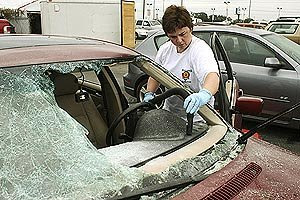
On a recent cloudy morning, Spaulding leans into a maroon BMW at a Ferman dealership in Tarpon Springs, swabbing a chemical-soaked paper towel under the steering wheel.

When she pulls out the towel, it is stained with blood.

She doesn't know any specifics about the car or the driver. She never asks. That would make it too personal.

She doesn't know if the driver of the BMW survived. She only knows about the deer because of clumps of fur and brain matter.

This day, she wears a company T-shirt and shorts. Double-sets of gloves protect her hands. Her goal is to wipe away every bit of gore so the family doesn't see a thing. She views her work as helping people in a different way than as a police officer. No one liked her then, she says. But now, people are grateful she's there. She offers a sort of fresh start, helping to ease their pain.

"When I leave, you'll never know anything happened," she says.

The money isn't bad, but it isn't enough for her to be full-time yet. She has three employees. When she's not cleaning, she sells medical equipment.

The job is unpredictable, and she carries a cell phone so she's always available. She'll travel anywhere in the state, but sometimes she can't get there quickly enough for victims' needs.

There's more than enough work to go around, she says. It's just a matter of letting people know she's there, she says.

"Every time you turn on your TV, there's another homicide or suicide or car accident," she says.

As she pulls at the shattered glass windshield, two car dealership employees approach her.

They peer at the car. "Nasty," says damage appraiser Rob Eldridge. He wrinkles his nose.

"This is a nightmare to fix, and I don't know what kind of stench will be in there," says the other, Cam Crollard, body shop manager.

"I'd say that's the worst mess I've seen in 36 years of doing this," Eldridge says.

As they watch from a few feet away, Spaulding continues wiping up the mess.

Times researcher John Martin contributed to this report. Abbie VanSickle can be reached at 226-3373 or vansickle@sptimes.com

Saturday, February 21, 2009

Crime Scene Cleanup: What It Involves


The Restoration Resource

A crime scene cleanup service is not without its complications. Crime scene cleaning encompasses restoring the crime scene to its original state. When a crime is usually discovered, crime scene cleaners are not called until after officers of the law, like the crime scene investigators, have done their jobs first and have given the go ahead for the cleaners to come in. If you intend to hire a crime scene cleanup company, you must make sure that they are well equipped and fit right to get the job done. A crime scene presents challenging conditions.

The Use Of Protective Gears:
Crime scenes can very well involve the use of hazardous or deadly substances. For safety reasons then, it has become imperative that crime scene cleaners use protective clothing, in addition to protective tools and gadgets. You must see to it that they have all the necessary protective gears and gadgets. The protective clothing can consist of disposable gloves and suits. A disposable gear is preferred nowadays since it offers the best protection against contamination. You use it one time and get rid of it. That way, the dangers of contamination is virtually brought down to zero percent. Protective clothing extends to respirators and the use of heavy-duty industrial or chemical-spill protective boots.

Among the gadgets that a crime scene cleaning company must have are special brushes, special sprayers, and wet vacuum. These special tools ensure added protection against getting into contact with the hazard could very well be present in the crime scene. There is large, special equipment such as a mounted steam injection tool that is designed to sanitize dried up biohazard materials such as scattered flesh and brain. You would also need to check if they have the specialized tank for chemical treatments and industrial strength waste containers to collect biohazard waste.

Of course, any crime scene clean up must have the usual cleaning supplies common to all cleaning service companies. There are the buckets, mops, brushes and spray bottles. For cleaning products, you should check if they use industrial cleaning products. A crime scene cleaning company must have these on their lists:

1 - Disinfectants including hydrogen peroxide and bleaches - The kinds that the hospitals used are commonly acceptable.

2 - Enzyme solvers for cleaning blood stains. It also kills viruses and bacteria.

3 - Odor removers such as foggers, ozone machines, and deodorizers

4 - Handy tools for breaking and extending such as saws, sledgehammers, and ladders

Established crime scene operators also equip themselves with cameras and take pictures of the crime scene before commencing work which. The pictures taken may prove useful for legal matters and insurance purposes. You never know which.

Needless to say, a specially fitted form of transportation and proper waste disposal is also needed. These requirements are specific. As you can imagine, crime scene cleaning is in a different category on its own. A home cleaning or janitorial service company may not be able to cope up with the demands of a crime scene. A crime scene cleanup service requires many special gears and tools that a home cleaning or a janitorial service company does not usually have or does not require. Crime scene cleaning if not done correctly can expose the public to untold hazards.

What Else To Look For In A Crime Scene Cleanup Company
You may also want to hire a company that has established itself. An experienced company with a strong reputation is always a plus but it could be expensive too. You will do well to balance your needs with what is your budget. There are several companies that offer specific prices such as for death scene clean up categories and suicide clean up categories. Most companies own a website and have round the clock customer service as receptionists.

When looking for a suitable crime scene cleaning service, among the first things you need to do is to scout for price quotes. Crime scene cleanup services usually provide quote after they have examined the crime scene and then they give you a definite quote. Factors that are usually considered include the number of personnel that will be needed to get the job done. It also includes the amount of time that might be needed. The nature and amount of the waste materials that need to be disposed will also be factored in. You can be sure that the more sophisticated equipments needed the more expensive it will get.

Crime Scene Cleanup And Your Insurance
For homeowners, the best approach is always to make sure that crime scene cleanup services clauses and provisions are written down on the contracts or policies. The inclusion of crime cleanup services clauses is very common and has become standard clause in most homeowner’s policy. Make sure that you are covered for this unforeseen event. Make sure that your policy directs the crime scene cleaning company to transact directly with the homeowner insurance company. A crime scene cleaning service is usually a standard clause in many homeowners’ insurance clause. These companies often do the paperwork in behalf of clients.

If for some reason you do not have such coverage by any policies relating to crime scene cleanup on your home, there are ways to keep your expenses controlled.

Finding the right company can be very taxing, especially that you have to deal with the emotional stress stemming from the crime itself, especially with a crime scene involving death.

There are many crime scene cleanup companies in operation nowadays. There are reliable professionals that you can hire and prices are relatively competitive. As of recently, crime-scene cleanup services can cost up to $600 for an hour of their service. A homicide case alone involving a single room and a huge amount of blood can cost about $1,000 to $3,000.

In recent years, crime scene cleaning has come to be known as, "Crime and Trauma Scene Decontamination or CTS. Basically, CTS is a special form of crime scene cleaning focusing on decontamination of the crime scene from hazardous substances such as those resulting from violent crimes or those involving chemical contaminations such as methamphetamine labs or anthrax production. This type of service is particularly common when violent crimes are committed in a home. It is rare that the residents move out of the home after it has become a scene of a crime. Most often, the residents just opt to have it cleaned up. That is why, it is very important to hire the best crime scene cleaning company out there. The place needs to be totally free from contamination of any kind. You have to make sure that the company is able to remove all traces of the violent crime that took place. This includes cleaning biohazards that are sometimes invisible to the untrained eye.

Legally speaking, federal laws state that all bodily fluids are deemed biohazards and you should make sure that the cleanup service company you hire understands this and includes it in the cleanup. These things appear as blood or tissue splattered on a crime scene. You must be able to hire a company that is equipped with special knowledge to safely handle biohazard materials. The company must have the knowledge what to search for in any give biohazard crime scene. For instance, the company should be able to tell clues such that if there is a bloodstain the size of a thumbnail on a carpet, you can bet that there is about a huge bloodstain underneath. Federal and State laws have their own laws in terms of transport and disposal of biohazard waste. Make sure that the company you hire has all the permits necessary.

It will also be a huge plus if you could hire people who not only has the special trainings but also who have the nature to be sympathetic. If you are close to the victim and have the cleaning done at the behest of the victim’s relatives, it would matter that the cleaners tread the site with some level of respect. It is a common site that family members and loved ones are often there at scene. In general, when looking for a suitable crime scene cleaners, you would take into considerations the kind of situation that the crimes scene presents and the demands that it require. Crime scene cleaning companies handle a wide variety of crime scenes and prices may vary from one to the other crime scene and one to the other company.

Each type of scene requires its own particular demands not only to make the crime scene look clean and neat on the surface but to make it germ free, and clean inside and to make it free from all deadly and infectious substances. The cleanup cost for biohazards may vary depending on degree of the bio hazard(s) on the scene. There may even be a category that changes the cleanup pricing which usually involves decomposing bodies and carcasses. Likewise, a cleanup of chemical hazards vary, depending on the amount of chemical hazards as well as the grades i.e. how hazardous the substance is in terms of human contact. Prices are also determined by the number of hours and personnel that it would to get the crime scene cleaned. In addition, the "gross factor" from crime scene involving death and gore needs to be taken under consideration regarding the chemicals that will be used as opposed to those crimes' that do not have gore involved.

Thursday, February 19, 2009

Risks of Using In-house Employees for Environmental Cleanups


By Gerard M. Giordano, Esq.

In an attempt to save money, property owners may be tempted to use their own Employees to clean up contamination at their facilities in order to comply with state or federal environmental laws. However, there may not be any real savings because when property owners (as employers)do commit to such a venture,they must comply with the Occupational Safety and Health Administration’s (OSHA)regulations that may be applicable. These are designed to protect employees from occupational injuries and illnesses,and failure to comply with these regulations could result in fines that may offset any savings.

A property owner who orders his employees to clean up or work with hazardous substances must comply with a number of precautionary regulations. The most comprehensive is 29 CFR 1910.120, which deals with hazardous waste operations and emergency response. An employer is required to develop and put into writing a safety and health program for any employees engaged in hazardous waste cleanup operations.

The elements of an effective program include requiring an employer to identify and evaluate specific hazards and to determine the appropriate safety and health control procedures to protect employees before any work is initiated. Likewise, protective equipment must be utilized by employees during the initial site entry and, if required,during subsequent work at the site. The employer must also periodically monitor employees who may be exposed to hazardous substances in excess of OSHA ’s regulations.

Once the presence and concentration of specific hazardous substances and health hazards have been established, employees involved in the cleanup operations must be informed of any risks associated with their work. Under certain ircumstances,regular ongoing medical surveillance of employees by a licensed physician, and without cost to the employees or lost pay, may be required.

Numerous other safeguards are also required by OSHA. For example, OSHA’s hazardous communications program, 29 CFR 1910.120, requires an employer to establish and implement a hazard communication program if, during the course of the cleanup, employees may be exposed to hazardous chemicals.

The requirements are essentially the same as those in workplaces where employees are routinely exposed to hazardous chemicals. The program must include container labeling, production of material safety data sheets and employee training. The employer must also provide a full description of the OSHA compliance program to employees, contractors and subcontractors involved with the cleanup operations as well as OSHA,and to any other federal,state or local agency with regulatory authority over the cleanup.

Regulation 29 CFR 1910.120 also requires an employer that retains the services of a contractor or subcontractor to inform them of any identified potential hazards of the cleanup operations. Generally, it is the involvement of employees that triggers an employer’s obligations under the Occupational Safety and Health Act. If contractors were retained, it would be the contractors’ responsibility to comply with these OSHA requirements on behalf of their employees, assuming that the employer
retaining the contractor has neither employees involved in the cleanup nor employees potentially exposed to health hazards arising from the cleanup.

In addition to the contractor’s required compliance with OSHA regulations, it is imperative that a property owner include in any agreement with the contractor that the contractor must comply with all pertinent OSHA regulations. If possible,the agreement should also provide for indemnifications from the contractor to the property owner for claims arising from the cleanup. These indemnifications will be important if the employees of the contractor are injured or subsequently become ill because of such work. The indemnifications should survive the completion of the work. These precautions will help insulate the property owner from both governmental actions and potential third-party claims.

Failure to comply with OSHA regulations on the part of the property owner who uses his own employees to perform a cleanup or work with hazardous substances may result in substantial penalties. Under OSHA, fines can be levied for each violation found by an inspector. These violations can result in non-serious, serious or willful violations with penalties as high as $70,000 for each violation. If a subsequent inspection is performed and violations are found which have not been corrected from an original inspection,daily penalties could be levied resulting in substantial fines.

Compliance with OSHA regulations should be a factor when a property owner decides to use in-house employees for cleanups. In the long run, there may not be any savings to the employer. Furthermore, because of the employer’s lack of familiarity with the OSHA regulations governing the cleanup of hazardous sites,the employer could be subject to fines as a result of its failure to comply with the OSHA regulations.

Therefore, it may be prudent in the long run to retain a company whose business is devoted to doing only cleanups. This company will have the expertise and continuing obligations to protect its employees.

Gerard Giordano is special counsel at the law firm of Cole, Schotz, Meisel, Forman & Leonard, P.A., based in Hackensack, NJ. He is a member of the firm’s Environmental Department, and his practice focuses particularly on OSHA matters. Prior to practicing law, Mr. Giordano worked at the U.S. Department of Labor – Occupational Safety and Health Administration (OSHA) as an industrial hygiene compliance officer.

Saturday, February 14, 2009

Cleaning with compassion: Scene Clean


By Andrea M. Galabinski

Scene Clean owners Alice N. Jackson, left, and Tracy Gunn dressed in biohazard suits believe in compassion for their clients. They are in a very unique business, something like a cross between Mr. Clean and CSI. The owners of Scene Clean, Tracy Gunn and Alice N. Jackson, take the business very seriously, and consider the best way to describe what they do as "cleaning with compassion." The women provide crime and trauma scene cleanup, with 24 hour emergency services.

The scenes can include crimes, such as homicide, suicide and unattended death, all very traumatic times for clients. They work with policing agencies throughout Southwest Florida and for private clients.

"When tragedy strikes, we're here to relieve others of the burden of preforming such a traumatic and possibly dangerous task clean up can be," said Gunn. "We discreetly and safely restore the scene." They work within strict OSHA and Department of Health regulations, and get regular training. They wear full biohazard suits for the clean ups.

It's not a subject many feel comfortable talking about, and the two women know it. They care very deeply about the personal side of the tragedies.

Jackson grew up around the bereaved. Her father was a funeral director in her hometown in New Jersey. "He never missed a day of work in 45 years, until he got cancer," she said. The death of her parents effected her deeply, and she truly feels for the individuals they work for. Another thing point for their company is that they've made their services affordable. "We don't want to victimize them twice," she said. "First with their own tragedy, and then the burden of a huge bill."

Gunn was born and raised here in Naples, and is an extremely upbeat individual, yet very serious when she talks about what the two do. They are best friends, and both moms of nine year olds. "Motherhood comes first," said Gunn. They are also proud to be certified woman business owners and are registered with the state.

They have been in business now for three years, but it was Jackson's father's own compassion for the grieving that inspired the idea years ago. "The family shouldn't have to do it. It shouldn't be their last memory," she said.

They also do what is called Distress Property, such as a home where the owner, before dying, had 37 cats that needed to be cleaned up after. It was a tremendous undertaking, they said.

"One of the hardest things is that sometimes we need to go through personal effects to get the job done. I'm very aware that we're strangers," said Gunn. "We respect that."

The job can be very emotional at times, both women said, in the light of tragedy. "You can't get a suit that protects you from that," said Gunn. Of the suits, they say they lose three to four pounds on each job, as they are hot and heavy. There is no exposed part of the body in what they do.

Gunn generally deals with the families. "It makes me feel like I'm helping them, giving my own condolences." They know that the whole subject is taboo, and people don't like talking about it. When they give out their cards, Gunn says, "I hope you never need our services. But if you do, we're here."

Saturday, February 7, 2009

The economic cost of methamphetamine use in the United States


Medical Research News

The economic cost of methamphetamine use in the United States reached $23.4 billion in 2005, including the burden of addiction, premature death, drug treatment and many other aspects of the drug, according to a new RAND Corporation study.
The RAND study is the first effort to construct a comprehensive national assessment of the costs of the methamphetamine problem in the United States.

"Our findings show that the economic burden of methamphetamine abuse is substantial," said Nancy Nicosia, the study's lead author and an economist at RAND, a nonprofit research organization.

Although methamphetamine causes some unique harms, the study finds that many of the primary issues that account for the burden of methamphetamine use are similar to those identified in economic assessments of other illicit drugs.

Given the uncertainty in estimating the costs of methamphetamine use, researchers created a range of estimates. The lowest estimate for the cost of methamphetamine use in 2005 was $16.2 billion, while $48.3 billion was the highest estimate. Researchers' best estimate of the overall economic burden of methamphetamine use is $23.4 billion

The study was sponsored by the Meth Project Foundation, a nonprofit group dedicated to reducing first-time methamphetamine use. Additional support was provided by the National Institute on Drug Abuse.

"We commissioned this study to provide decision makers with the best possible estimate of the financial burden that methamphetamine use places on the American public," said Tom Siebel, founder and chairman of the Meth Project. "This is the first comprehensive economic impact study ever to be conducted with the rigor of a traditional cost of illness study, applied specifically to methamphetamine. It provides a conservative estimate of the total cost of meth, and it reinforces the need to invest in serious prevention programs that work."

The RAND analysis found that nearly two-thirds of the economic costs caused by methamphetamine use resulted from the burden of addiction and an estimated 900 premature deaths among users in 2005. The burden of addiction was measured by quantifying the impact of the lower quality of life experienced by those addicted to the drug.

Crime and criminal justice expenses account for the second-largest category of economic costs, according to researchers. These costs include the burden of arresting and incarcerating drug offenders, as well as the costs of additional non-drug crimes caused by methamphetamine use, such as thefts committed to support a drug habit.

Other costs that significantly contribute to the RAND estimate include lost productivity, the expense of removing children from their parents' homes because of methamphetamine use and spending for drug treatment.

One new category of cost captured in the analysis is the expense associated with the production of methamphetamine. Producing methamphetamine requires toxic chemicals that can result in fire, explosions and other events. The resulting costs include the injuries suffered by emergency personnel and other victims, and efforts to clean up the hazardous waste generated by the production process.

Researchers caution that their estimates are in some cases based on an emerging understanding of methamphetamine's role in these harms and should be further refined as understanding of these issues matures. The RAND report also identifies costs that cannot yet be adequately quantified.

"Estimates of the economic costs of illicit drug use can highlight the consequences of illegal drug use on our society and focus attention on the primary drivers of those costs," Nicosia said. "But more work is needed to identify areas where interventions to reduce these harms could prove most effective."

Methamphetamine is a highly addictive substance that can be taken orally, injected, snorted or smoked. While national surveys suggest that methamphetamine use is far from common, there is evidence that the harms of methamphetamine may be concentrated in certain regions. One indicator of the problem locally is treatment admissions. Methamphetamine was the primary drug of abuse in 59 percent of the treatment admissions in Hawaii in 2004 and accounted for 38 percent of such admissions in Arizona in 2004.

Wednesday, February 4, 2009

Woman Wanted For Illegally Dumping Medical Waste


WJXT-TV

ST. AUGUSTINE, Fla. - Authorities are looking for Pamela Niland for allegedly dumping two hazardous waste bins into a Dumpster behind a construction company's building.

Deputies said they believe Niland is the woman caught on a surveillance camera getting out of a maroon sport utility vehicle and opening the rear hatch, only to remove a garbage bag containing two red biohazard containers.

Authorities said the containers contained used needles, blood and vials of medicine and drugs. Police reports said that once authorities made contact with Niland, she claimed to have been fired from Flagler Hospital in September for allegedly stealing narcotics from the hospital.

Police reports said the construction company's owner saw the SUV in the rear of the building and became suspicious, compelling him to look at the surveillance video. After seeing what she disposed of, the company's owner called the police.

A warrant has been issued for Niland's arrest, but as of Saturday she has not been arrested. A representative from Flagler Hospital said the containers were stolen from that hospital and that they wish to press additional charges.

Lawsuit: St. Joseph's Hospital mold killed three children


TAMPA — Last spring, three young cancer patients died within a month of one another after stays at St. Joseph's Hospital.

But cancer didn't kill them, according to a lawsuit filed Tuesday.

Attorney Steve Yerrid says the children were exposed to a dangerous fungus released during a hospital construction project. Their immune systems already weakened by disease, the children succumbed to mold-related infections, the suit alleges.

The children's parents are suing the hospital for negligence, contending that it failed to protect its most vulnerable patients. Yerrid, who has a track record of winning large verdicts against local health care providers, spoke Tuesday on behalf of the families.

"They know that the system can never bring back their children," he said. "But they know that the system can deliver safety for other children."

Though she could not comment specifically on the lawsuit or the patients, St. Joseph's spokeswoman Lisa Patterson said the hospital is careful to use barriers and filter the air around its construction areas.

"Anytime we do any kind of construction we follow all the necessary precautions," she said. "Obviously, patient safety is the top priority for the children's hospital."

As part of a $1 million renovation to its children's oncology center, St. Joseph's last year tripled the size of the outpatient area where young cancer patients receive their chemotherapy, creating private treatment rooms equipped with flat-screen TVs.

The children represented in Yerrid's lawsuit had been formally admitted to the hospital, and spent many of their final days in rooms one floor above the construction activity.

The lawsuit says the hospital did not guard those rooms from contaminated dust and airborne particles generated by the demolition and removal of plaster walls and ceiling tiles.

The Centers for Disease Control and Prevention estimates that 2 million infections from a variety of causes are acquired each year in health care settings, resulting in 90,000 deaths.

Parallel cases

Yerrid's lawsuit details three sad and parallel fates.

Mathew Gliddon, 5, battled acute lymphoblastic leukemia on and off for three years. The cancer attacks the body's white blood cells, which normally fight infections.

Last March, his parents, Mathew and Karen Gliddon, expressed concerns to St. Joseph's infection control nurse about fumes and odors that seeped into their son's room from smokers and vehicles outside the hospital. They also worried about children sharing the same passageways with construction workers when they were transported to the main hospital for services, the lawsuit states.

That month, doctors removed most of young Mathew's nose due to an invasive nasal sinus fungal infection. He died on April 16, 3½ weeks after doctors discharged him. An autopsy showed that his death was caused by chemotherapy and a fungi infection.

Sierra Kesler, 9, died May 3. Born with Down's syndrome, she also was diagnosed with acute lymphoblastic leukemia.

She was admitted to St. Joseph's several times in early 2008 for pneumonia, sinusitis and a cancer relapse. In April, after her cancer was back in remission, Sierra returned to the oncology ward for treatment. After several weeks there, she experienced significant respiratory distress and, according to the lawsuit, contracted a fatal lung infection caused by mold.

Her autopsy listed the cause of death as fungal pneumonia with underlying leukemia.

Kaylie Gunn-Rimes, 2, suffered from infantile acute lymphoblastic leukemia. She spent three weeks on the first floor at St. Joseph's Hospital in January 2008 getting treated for an allergic drug reaction. Tests showed no recurrent cancer.

By February, she developed a lung infection caused by mold. She died May 13 of respiratory failure.

Each child's infection was linked to aspergillus, a common mold found virtually everywhere, including in soil, air and construction dust. Most people breathe it in every day without harm. But the mold can cause serious or deadly infections in people who have undergone chemotherapy or organ transplants.

"In normal people we live with them, and they don't cause infection in us because our bodies are able to repel them," said Dr. Russell Vega, chief medical examiner for Sarasota, Manatee and Desoto counties. "It's not until our bodies become compromised … that those normally innocuous bacteria and fungi can get a foothold in the body and cause disease."

Other incidents

Yerrid could not say whether other children had suffered from mold infections at St. Joseph's. Similar cases of patients dying or becoming seriously ill after being exposed to mold in hospitals have been reported in recent years in Colorado, New York and Australia.

Patterson, the hospital spokeswoman, said St. Joseph's has an infection control team that works to ensure a clean and healthy environment. Hospital procedure includes preventive maintenance rounds and measuring air quality, she said.

Yerrid, 59, says those efforts fell short.

"There are simple protocols," he said, "that should and could have been followed."

Times researcher John Martin contributed to this report. Colleen Jenkins can be reached at cjenkins@sptimes.com or (813) 226-3337.

Spaulding DECON Cleans Florida

Sunshine Cleaning (March 13th 2009)


Sunshine Cleaning is a comedy-drama starring Amy Adams and Emily Blunt.

Sunshine Cleaning follows an average family that finds the path to its dreams in an unlikely setting. A single mom and her slacker sister find an unexpected way to turn their lives around - once the high school cheerleading captain who dated the quarterback, Rose Lorkowski (Amy Adams) now finds herself a thirty something single mother working as a maid. Her sister Norah (Emily Blunt) is still living at home with their dad Joe (Alan Arkin), a salesman with a lifelong history of ill-fated get rich quick schemes. Desperate to get her son into a better school, Rose persuades Norah to go into the crime scene clean-up business with her to make some quick cash. In no time, the girls are up to their elbows in murders, suicides and other…specialized situations. As they climb the ranks in a very dirty job, the sisters find a true respect for one another and the closeness they have always craved finally blossoms. By building their own improbable business, Rose and Norah open the door to the joys and challenges of being there for one another—no matter what—while creating a brighter future for the entire Lorkowski family.

Here’s the Sunshine Cleaning Trailer, hit HQ in the menu bottom right for improved quality. The movie is due out March 13, 2009.

Tuesday, February 3, 2009

Estates man gets 5 years for Hurricane Wilma insurance scam

Naples Daily News

Friday, January 30, 2009

NAPLES — A 40-year-old Golden Gate Estates man who accepted kickbacks for referring Hurricane Wilma home-repair work to a Naples contractor was sent to prison for five years Friday after pleading guilty to a roughly $76,000 insurance fraud scheme.

Edward Joseph O’Neil, once an insurance adjuster for Cincinnati Insurance Co, was adjudicated guilty of scheme to defraud, a first-degree felony, and Collier Circuit Judge Fred Hardt, sentenced him to 10 years of probation after his release. He also ordered him to pay $632.82 monthly over that period to pay off the $75,938.50 in restitution to his former employer.

O’Neil, who wore a suit, said little during his sentencing, except to say he understood he was waiving away his rights to a trial and an appeal. Hardt ordered him to have no contact with contractor Edward Byrnes, who operates K & B Builders in East Naples, and his wife, Diane. Byrnes cooperated with the State Attorney’s Office and his case is pending before another judge. O’Neil had faced up to 30 years in a state prison, but was sentenced as part of a plea agreement negotiated by Assistant State Attorney Jim Molenaar and defense attorney Burt Stutchin.

The prosecutor told the judge on Wednesday that further investigation showed the amount embezzled by O’Neil was more than $100,000. “I never saw any evidence that would warrant that,” Stutchin said as he left the courthouse after sentencing. “The penalty was severe enough.” O’Neil faced trial next week and had accepted a plea deal Wednesday, but Hardt rejected the agreement to two years of house arrest followed by probation and restitution.

Stutchin tried to withdraw as attorney after Hardt denied a ruling asking that the judge not preside over the case. The motion said Hardt would be biased because he’d worked as counsel for Cincinnati Insurance and understood the workings of the insurance industry. Hardt angrily denied Stutchin’s interpretation of what he’d said, adding, “I know what I said.” Stutchin withdrew his motion to withdraw on Wednesday, then reinstated it after Hardt rejected the plea deal. He was to argue the motion Friday, but they reached the plea agreement.

After Hardt was told of the sentence, Stutchin asked for a 90-day furlough so O’Neil could tie up family affairs. “No. Not on a five-year sentence,” Hardt tersely replied. O’Neil then pleaded with him for time, at least 30 days before he turned himself in for sentencing. “I have a father in law, who has been like a father to me, who has Guillain-Barré disease,” O’Neil said. “My mom lives with me as well and she’s indigent.” Hardt again refused and said he could plead later or go to trial.

Looking like he was about to cry, O’Neil walked outside the courtroom with the attorneys and later returned, pleaded and was sentenced. His wife, Laurel, who had been at the hearing Wednesday, was not there and learned over the phone her husband would be leaving her and their children for five years. He was given credit for the one day he served in county jail before he posted $15,000 bond five hours after his arrest on March 6. 2008.

Saturday, January 31, 2009

Cleaning Up After Violent Deaths in Florida


By JILL SHATZEN Special to The Sun
BRANDON KRUSE/The Gainesville Sun


Crystal Pinkston and her husband Dan Pinkston own Accident Cleaners Inc., a business that specializes in cleaning up after a death — the blood, fluids, etc. — so that grieving families don’t have to.

Dan and Crystal Pinkston say they lead as normal a life as they can, given their occupation. But when their business gets the call to clean up a mess, we’re not talking an ordinary mess. Their business is Accident Cleaners Inc., a trauma and crime scene cleanup service that Dan, 37, has owned and operated since 2001 and now shares with his wife, Crystal, 25.
Their job is to clean up the aftermath of a death — the blood, fluids, etc. — so that grieving family members don’t have to. The glossy brochure they place into the hands of their heartbroken clients displays photos of sad faces and words like, “Compassion in Crisis” and “You repair your heart, let us repair your home.” And that’s what they do.
“You’ve got to be careful,” Dan said. “You don’t want to use the word ‘understand’ because you don’t understand. So we try to be as polite as we can be and get the job done fast and quick so they can get on with their healing.”

The unusual business idea was the brainchild of Dan Pinkston, who, after working as a firefighter with the Ocala Fire Department for more than a decade, said he began to see a trend. He said many times he would be on a job where casualties occurred and the family members would look to the firemen to clean up the mess.

“The thing is, the fire department doesn’t do it, the police department doesn’t do it, so the family members were left to clean it up,” he said, before Crystal added, “They really had no choice.”
That’s when Dan Pinkston said he realized that there was a demand for a business that would do the job that no one wanted to do, and do it in a sensitive, compassionate way. He traveled to Boston in 2001 to take a week-long class to become certified by the American Bio-Recovery Association but found he had already fulfilled many of the requirements through the fire department.

After being in business for about four years, Dan met Crystal through a set-up by a mutual friend, and the two were married in October 2007. For Crystal Pinkston, taking on the business wasn’t as big of a shock as it could have been.

“I was in the janitorial services business before we met,” she said. “I started my own business and had it for about five years or so, and he was in this business already, so it was just kind of transferring over to a different kind of cleaning.”

The Pinkstons said that while business has steadily increased since they began in 2001, there are limits to the number of calls they receive. On average, they said they receive about two calls per month, and added that several have been high-profile crimes.

“We’re not living in Miami or New York,” Dan said. “We don’t have the crime that those areas have. We stay busy, but it’s not going off the charts and we’re happy about that.” Crystal agreed, saying, “You don’t just sit around and pray for business by any means. Business is good, but we don’t want to encourage anyone.”

Both said that sometimes it’s hard not to take the job home with them. Dan said the hardest job he has ever had to do was clean up after the suicide of a 12-year-old boy. For Crystal, it’s the homicides that hit her the hardest.

“In a homicide you have to think about the fact that someone was murdered,” she said. “They were taken by surprise; it was not their free will to come in and have this happen to them. It’s difficult for me just seeing how someone struggled trying to stay alive in these cases.”
Still, they maintain that being in it together is what helps them through.

“It just all goes back to helping people,” Dan said. “That’s why you do it.”

BUSINESS IS CLEANING UP AFTER FAMILY TRAGEDY, WOMAN FORMS FIRM TO SANITIZE SCENES


By Linda Trischitta

When Joan Dougherty's relative died at home, she did the only thing she could think of: rolled up her sleeves and cleaned his house. The experience was physically and emotionally exhausting for Dougherty, who was working as a hairstylist at the time.
"When I asked law enforcement who could help us, and this was in the early 1980s, there was nobody," said Dougherty, 64. Seeing a need, she formed her own company in a growing field: crime scene cleanup.

"I know what it's like to be in that situation," she said. "I've been there."
Name a South Florida disaster and Dougherty's 12-year-old Margate company, AA Trauma Cleaning Service, has been there, too. With five employees, she's on call around the clock, starting at $125 an hour. Her clients often are reimbursed by insurance.When the American Media Inc. building in Boca Raton was contaminated with anthrax in 2001, her company evaluated conditions inside and cranes lifted her employees to work on rooftop air- conditioning units.

When two planes crashed over the Boca Grove Plantation community in 2000, she got the call. AA Trauma also has handled norovirus outbreaks on cruise ships. More typical than the headline-grabbing cases are the hurricanes that bring mold growth or flooding to overwhelmed homeowners; suicides in motels, or elderly hoarders who lose control of their property. "I once took at least 1,000 bottles from a kitchen," she said. "It was a sad situation."

She has attended numerous courses in topics such as sewage back flow and is licensed to transport biomedical waste. "The dead body, pre-embalming, is a biohazard," said Dougherty, who tackles a scene after a corpse is removed. She takes care not to disturb the possessions of the deceased. "There's no such thing as closure," she said. "With the belongings, that was part of that loved one's life, and that's what the survivors are holding on to."
Dougherty is the go-to gal for a lot of folks in the business who encounter unique situations. Ron Gospodarski of Bio-Recovery Corp. in New York tapped her to help clean up anthrax at ABC-TV headquarters. "I consult with her on things that we don't have here," he said. "For instance, cops may use tear gas in Florida. We don't use it that often in New York. She will go out of her way to help you solve your issue." He said he admires her stamina. "It's hard work and I give her a lot of credit. The physical side of it, it's really unpleasant, some of the most gut-wrenching odors you've ever smelled in your life," Gospodarski said.

To keep odors at bay, Dougherty typically wears a respirator, removes the smelly source from the scene and, after cleaning up, sprays a suppression product that grabs odor molecules.
John O'Malley, the Palm Beach County Health Department director of environmental health and engineering, called Dougherty for the AMI job. "She had to provide a health and safety plan that was approved by a lot of agencies and it was a unique situation; we were flying by the seat of our pants," he said. "They were qualified to handle that."

One dark Friday night found her helping Michael Spindell, biomedical waste coordinator for the Broward County Health Department, retrieve test tubes filled with fluids that were illegally dumped in a canal. "We had to retrieve them all, 20 or so," she said. "That was tough because it was nighttime and there are alligators. We were at the edge on the slope, with our feet in the water." "She was extremely knowledgeable in manner and expertise and is well thought of in the industry," said Spindell, who has seen Dougherty lecture to biomedical waste coordinators upstate.

"What you are not seeing is what you should be concerned with," Dougherty said of what clients may have to cope with. "You have to capture blood and outflow that can migrate. It can get trapped under a seal plate [that supports wall studs] or wick up into base molding and drywall."
Kent Berg, founder of the 12-year-old American Bio-Recovery Association, estimates the industry is 25 percent female-owned, with 600 to 700 companies in the United States. The industry is expanding in Florida because of the growing population, crime and a large elderly segment.

Berg said there are no federal standards for the industry. "There is a disturbing number of untrained and uncertified companies that we hear about through attorneys and attorney general offices and insurance company complaints," said Berg. "We're appalled by the lack of quality of their work and the exorbitant prices they are charging." He said it's not unheard of to have a kitchen cleaned up, a family return home and have blood spurt up from between the floor tiles. "In this kind of work it's all about the details and protection from biohazards, and we're not seeing that in some places."

Linda Trischitta can be reached at ljtrischitta@sun- sentinel.com or 954-356-4233.

DEP Agents Arrest Jacksonville Doctor for Improperly Disposing of Biomedical Solid Waste


-Approximately four garbage bags of biomedical waste found in dumpster-


JACKSONVILLE -Florida Department of Environmental Protection (DEP) law enforcement agents arrested Dr. Napoleon Depadua of Industrial Medicine Group on Wednesday for improperly disposing of approximately 200 pounds, or four garbage bags, of biomedical waste in a dumpster. Depadua was charged with Improper Disposal of Solid Waste (Biomedical), a first degree misdemeanor punishable by up to six months imprisonment and/or a fine of up to $10,000.
“Disposing biomedical waste without following the proper procedure is unsafe and compromising to the environment,” said DEP Division of Law Enforcement Director Henry Barnet. “Thanks to assistance from the Duval County Department of Health, we were able to solve this environmental crime quickly and efficiently.”
DEP law enforcement agents were alerted on Wednesday by the Duval County Department of Health (DOH) of a possible crime. After DEP and DOH officials examined the contents of the Industrial Medical Group dumpster, they determined that the waste was biomedical and generated by Industrial Medicine Group. Further investigation led agents to Depadua, who had dumped the waste rather than having it disposed of by a registered biomedical waste transporter. Depadua provided a sworn written statement admitting that he alone illegally disposed of the biomedical waste into the dumpster on the afternoon of July 15, 2008, and was issued a notice to appear in court.

DEP’s Division of Law Enforcement is responsible for statewide environmental resource law enforcement, providing law enforcement services to Florida’s state parks and greenways and trails. Agents investigate environmental resource crimes and illegal dredge and fill activities, and respond to natural disasters, civil unrest, hazardous material incidents and oil spills that can threaten the environment.
To report an environmental crime, wireless customers can now dial #DEP. Callers can also report environmental crimes to the State Warning Point by calling (877) 2-SAVE-FL (1.877.272.8335). General environmental inquiries should be directed to DEP district offices during business hours.
For more information about DEP’s Division of Law Enforcement, visit www.dep.state.fl.us/law.

Jacksonville Man Arrested for Dumping Biomedical Waste


JACKSONVILLE –

Late Friday, Department of Environmental Protection (DEP) law enforcement agents arrested Mitchell Scott Keane, age 34, of Jacksonville for the theft and improper disposal of biomedical waste.
Over the last two months, DEP law enforcement agents partnered with the Jacksonville Sheriff’s Office and the Duval County Health Department to investigate the theft of biomedical waste from St. Vincent’s Medical Center and Baptist Medical Center. Keane was arrested as DEP agents observed him illegally disposing of the waste into commercial dumpsters. Agents also recovered more than 674 pounds of biomedical waste from his residence.
Keane is charged with a felony violation of the Florida Litter Law, felony theft and trespassing. If found guilty of the felony charges, Keane could face up to five years in jail and a fine of $5,000. No court date has been set.

Pasco County Man Arrested for Illegally Dumping Biomedical Waste


PORT RICHEY–
Department of Environmental Protection (DEP) law enforcement officers today arrested Andrew Tierney Froelich, age 54, owner of ServPro in Port Richey, for illegally dumping biomedical waste.During a six week investigation, in partnership with the Pasco County Health Department and the Pasco County Sheriff’s Office, DEP law enforcement officers observed Froelich illegally disposing biomedical waste into a commercial dumpster.Froelich is charged with 3rd degree felony commercial dumping. Charges are pending for transportation of bio-medical waste without a permit and causing a public nuisance. If found guilty, Froelich could face up to five years in jail and a fine of $5,000. No court date has been set.

Norovirus Outbreak on Hawaiian Waters


By Ron Mizutani
A highly contagious virus sickened dozens of passengers during a recent cruise aboard the "Pride of America."The United States Food and Drug Administration confirms Norwegian Cruise Lines reported a Norovirus outbreak on a cruise in Hawaiian Waters.


Sources tell KHON more than 67 of the 1,837 passengers aboard the "Pride of America" between January 17th and the 24th were stricken by the virus."Norovirus is something that is always a problem in a confined environment where there are multiple different people coming together," said Dr. Alan Tice, infectious disease consultant. "Sometimes the diarrhea can be so bad that it is serious and occassionally people have to be hospitalized for it and it can be very miserable."The Norovirus is a short-lived infection but the virus has shown up in stool samples taken eight weeks after an outbreak. State health officials could not comment on the case because it is a federal investigation but acknowledged it is assisting the F-D-A. They add all islands are on alert."And I think that's an error on the part of the Department of Health and the Food and Drug Administration -- these matters are serious they should be taken care of -- they should be addressed to the public in a timely fashion," said Carroll Cox of Envirowatch. "Things fall through he cracks because of bureaucracy."


The Pride of America is currently on another inter-island cruise. N-C-L did not return our calls."The procedures for Norovirus are pretty clear in terms of cleaning they have special cleaning agents in general that they use," said Tice. "They go around and general do an extraordinary job cleaning anywhere from door knobs, to carpets, to whatever that may be affected pools etc. where this virus can persist for a matter of often days."In November 2007, about 400 out of 25-hundred passengers were stricken with Norovirus aboard the Pride Of Hawaii, the largest epidemic on a cruise ship of that size in '07. State health officials encourage anyone diagnosed with the virus to wash their hands after using the bathroom. Critics say that's not enough."This incident occurs and no transparency -- the public is not informed," said Cox. "If the state health department is involved -- than the state health department has a responsibility to inform the public."In addition to the 67 passengers, 14 employees were also sickened by the virus.

When the Police Call 911


by Andrew Yurchuck


Police officers work in a hostile environment. Danger lurks with every car stop and around every corner. Every modern police department issues its officers bullet-resistant vests to help keep them safe. Departments are very good at being proactive with immediate dangers. Many times, though, they overlook the threats that can affect their officers’ lives over the long haul, such as bloodborne pathogens.

Just one workman’s compensation claim for a police officer can cost a department millions of dollars in claims. Most departments are self-insured, or are part of a joint insurance fund that pays medical and general liability losses. The medical costs can be catastrophic for small departments.According to the United States Centers for Disease Control, in the general population, one in 300 people are HIV positive; one in 20 have Hepatitis, one in five have herpes and one in three have some type of bloodborne disease. If the statistics aren’t scary enough, keep in mind that police officers work every day around populations with an increased risk of carrying bloodborne pathogens, such as intravenous drug users, prostitutes and habitual offenders that have been incarcerated in close quarters for the long term. To complicate matters further, many of the people these officers deal with don’t even know they are sick or infectious.
Several lawsuits have been filed by present and former prisoners that have been exposed to bloodborne pathogens due to lack of cleanliness or being forced to occupy or clean up a space that had been contaminated with known body fluids. OSHA mandates police officers receive annual bloodborne pathogens training. However, this training is often inadequate for them to properly decontaminate the eventualities they may encounter on the job. Herein lies the opportunity for the bio-recovery specialist.

Different companies will operate in different ways, depending on location, department size, budget and time constraints, and other factors. For example, we service 70 contracts to clean patrol cars and jail cells, operating with round-the-clock service to get the police department cars and cells back into service fast (95 percent of calls for service are after hours and on weekends).

Bio-recovery companies that decide to offer these services must respond as rapidly as possible. Jobs like this can’t wait until Monday morning (or even until the next morning, for that matter). The service is most valuable to small departments, those that may operate with fewer than four holding cells and 10 patrol cars. For these departments it’s critical to be up and operating as soon as possible because of limited resources; daytime, weekday cleanups are often provided by public works departments.

Properly equipped and trained bio-recovery firms may also find themselves presented with a related opportunity: providing ongoing maintenance service for patrol cars and cells. Holding cells can be deep cleaned using specialized equipment the municipalities don’t have access to or else do not know how to properly use. Cells can often be power washed, with the wastewater recovered for sanitary disposal. Pest control can also be a lucrative offering, especially when department heads see the problem firsthand. Firms performing patrol car and cell decontamination also have a built-in opportunity to reach new markets: the same departments and officers you are taking care of will turn into some of your greatest champions when it comes to restoration jobs in their communities. Put another way, patrol car and jail cell cleaning is an easy, powerful way to keep your company in front of your current customers and future referrals.

Paying for the Service
It would be great if all police departments included emergency service decontamination in their annual budgets, but that’s not always the case. In situations where funds may be otherwise unavailable, explore having the police department recover the cost of your services from the offender. For example, if the police pick up a drunk driver and he vomits in the patrol car on the way to the station (this happens more than you think) the department calls in your decontamination team and they go to work.

Have the billing office send the invoice to the department before the offender is released, and have them attach the invoice to the offenders arrest jacket for remuneration. Just like a fine, the offender doesn’t get their driver’s license back until the department gets reimbursed. This is a win-win situation for all parties involved. Hiring a contractor for cleaning out the cars and cells improves department morale, eliminates occupational exposure for the under-trained, under-equipped police officer and provides proper disposal and remediation outlet for medical waste and other contaminants being removed from department property. Costs for cleanups vary wildly depending on the severity; some companies use police decontaminations as loss leaders, but informal polls show companies typically charge between $150 and $700 a car.

The business of bio-recovery should not be entered into lightly. The same risks that you are protecting the police officers from are dangers that you will face on the job. Proper training and equipment is critical to staying safe on the job. The American Bio-Recovery Association, as well as various for-profit companies, can take your training in the right direction.

Thursday, January 22, 2009

Apartments evacuated after drug investigation


SPRINGDALE - Police conducting follow-up investigations at a Springdale apartment complex this week found remnants of two more methamphetamine manufacturing operations, prompting the evacuation of three neighboring apartments.
Springdale police on Friday arrested Adam Cline, 27, Kelly Cuesta, 37, Ashley Kilpatrick, 20, and John Sheeley, 60, on charges of possessing paraphernalia with intent to manufacture and possession of a controlled substance. All were arrested at 213 Erin Place, Apt. 202, said police spokesman Sgt. Shane Pegram.
Roommates Becca Ross and Tori Mooneyham are the only ones left in the four-plex, which was evacuated Monday after children at the apartment complex led police to a black bag containing methamphetamine production components.
"It's been a little bit inconvenient to say the least," Mooneyham said.
Ross said that she recently suffered a seizure she attributes to fumes from the lab. She said everyone living there has been feeling ill in the three weeks the unit has been occupied.
On Tuesday afternoon, police found remnants of a methamphetamine lab in an apartment previously occupied by the same four people, Pegram said.
"It looks like it was not a meth lab, but what's called lab trash," he said.
Pegram said that the findings required more tenants to be relocated, this time from 282 Erin Place. He said parts of that building were tagged for testing.
Another lab was found just south of the unit at 312 Erin Place in June.
Chief building official Mike Chamlee said he inspected the building as part of the Springdale Nuisance Abatement Program.
The black bag found behind the apartment contained several items, including a can of camp fuel and ammonia sludge, Chamlee said.
Chamlee said that the two adjoining apartment units were evacuated until tests can be done to determine whether there is any contamination from drug manufacturing.
Chamlee said that in the past two years about six labs had to be cleaned up throughout the city.
"It seems like when you find one you find two or three more fairly quickly," he said.
Cleaning the site will likely cost a minimum of $1,500 said Jerry Allred, principal broker for the firm that manages the apartment units.
Allred said he hopes the building can be cleaned quickly, but if not, they will discuss options with displaced tenants, such as possibly refunding a portion of their rent.
Legal action will likely be taken against the tenants of the unit, Allred said.
Once initial tests are done a cleanup plan will be developed, said Carlette Anderson, executive director of Haz-Mert, which handles and disposes of hazardous wastes.
Anderson said her firm is bidding on the Erin Place apartment, but she has not been in the building. Typically the test will determine what steps are taken.
High contamination levels could require the removal of drywall, Anderson said. She said the first step is to determine whether the presence of methamphetamine is above the state standard of 0.05 micrograms per hundred cubic centimeters.
Anderson said the cleanup could take weeks.
"A lot of times we have meth that permeates the walls," she said. "We may have to clean three times to get a good level - it's a lot of work."
Copyright © 2001-2009 Arkansas Democrat-Gazette, Inc. All rights reserved.